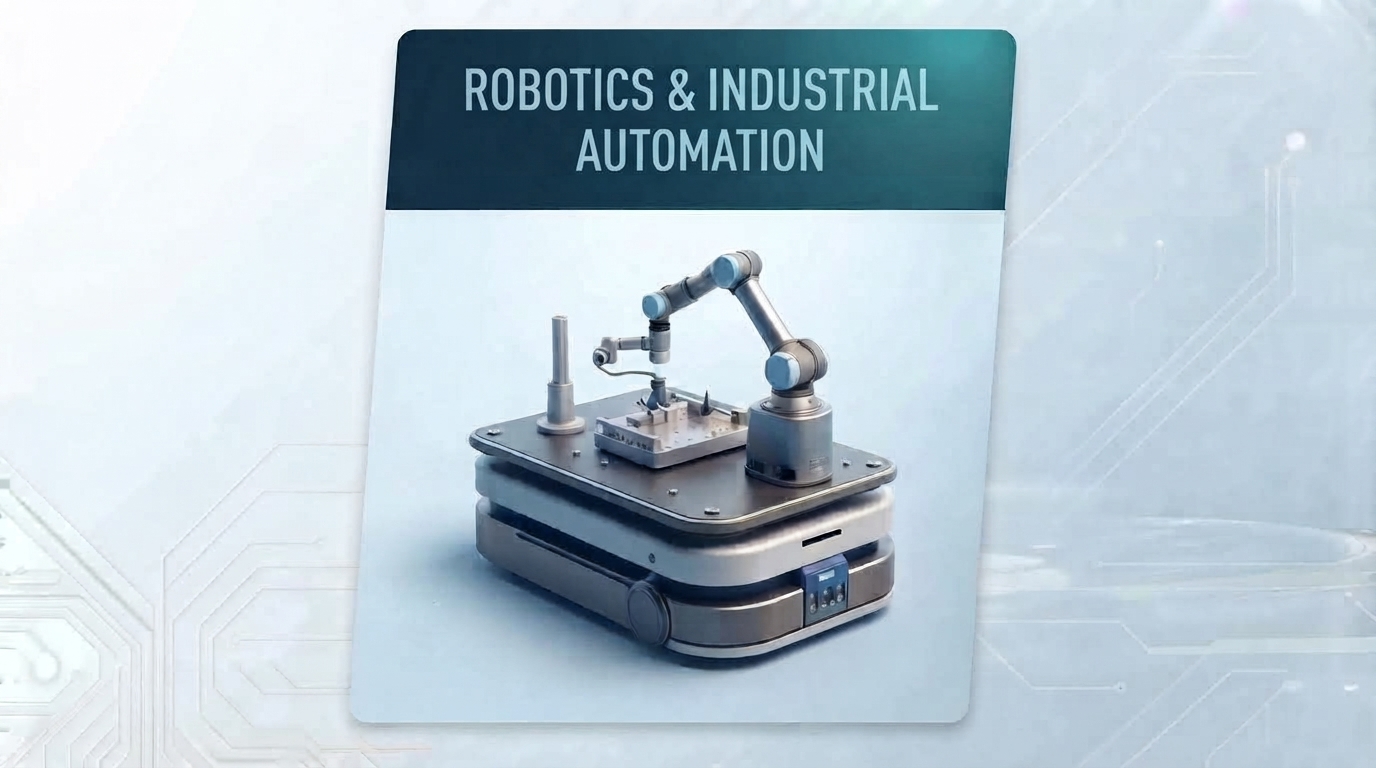
Robotics
SLAM
Healthcare & Hospitality
Indoor service robots for hospitals and hotels
The scenario: A robotics company is deploying autonomous service robots into hospitals and hotels. The robots must navigate unfamiliar indoor environments, avoid people, and stay accurate over long shifts — without on-site technicians.
How we help: We implement and tune the SLAM stack, build self-calibration routines that let the robot recover accuracy on its own, and harden the localization pipeline for real-world edge cases.
- Production-grade SLAM pipeline (ROS 2 or custom)
- Self-calibration and drift-correction routines
- Sensor fusion for camera, LiDAR, IMU, wheel odometry
- Field-testing harness and accuracy reporting
Warehouse
AMR
Fleet
Autonomous mobile robots for warehouses
The scenario: A warehouse automation company is deploying a fleet of AMRs into active distribution centres. Navigation, traffic coordination, and safe interaction with human pickers must all work together.
How we help: We build the fleet localization and coordination stack — map sharing, traffic scheduling, dynamic replanning, and safe handover to human operators.
- Fleet-wide localization and map sharing
- Traffic coordination and deadlock avoidance
- Dynamic replanning around obstacles and humans
- Integration with warehouse management systems
Industrial
Inspection
3D Perception
Industrial inspection robots
The scenario: A manufacturer is automating inspection with a robot-mounted 3D scanner. The perception pipeline works in the lab but fails on the factory floor where lighting, dust, and vibration vary.
How we help: We harden the perception pipeline for industrial conditions, add spatial registration and defect localization, and integrate with asset management systems.
- Robust 3D perception pipeline
- Point cloud registration and defect localization
- Integration with asset management systems
- Field validation and accuracy benchmarks
Sensors
Calibration
Fleet
Sensor pod calibration for fleets
The scenario: A company sells a sensor pod that combines cameras, LiDAR, and IMU. Every unit ships slightly different, and customers expect it to "just work" out of the box.
How we help: We design the factory calibration procedure, build the self-calibration logic that runs at boot and in the field, and deliver the tooling for manufacturing validation.
- Factory calibration procedure and tooling
- On-device self-calibration routines
- Extrinsic and intrinsic calibration pipelines
- QA reports and pass/fail thresholds per unit